Limit Calculator
Understanding limits is one of the most important parts of calculus because it explains how functions behave near a particular value. Our online Limit Calculator helps students quickly evaluate mathematical limits used in algebra, calculus, engineering mathematics, and physics applications.
Online Limits Solver
If you regularly solve derivatives, continuity problems, or rational expressions, using a reliable limits calculator can save significant time during practice and assignments. You can also explore more advanced mathematical tools available on All Calculator Canada for solving engineering and calculus equations online.
Students learning calculus often combine this tool with our dedicated Math calculators collection to solve algebraic expressions, transformations, integration problems, and function analysis from one place.
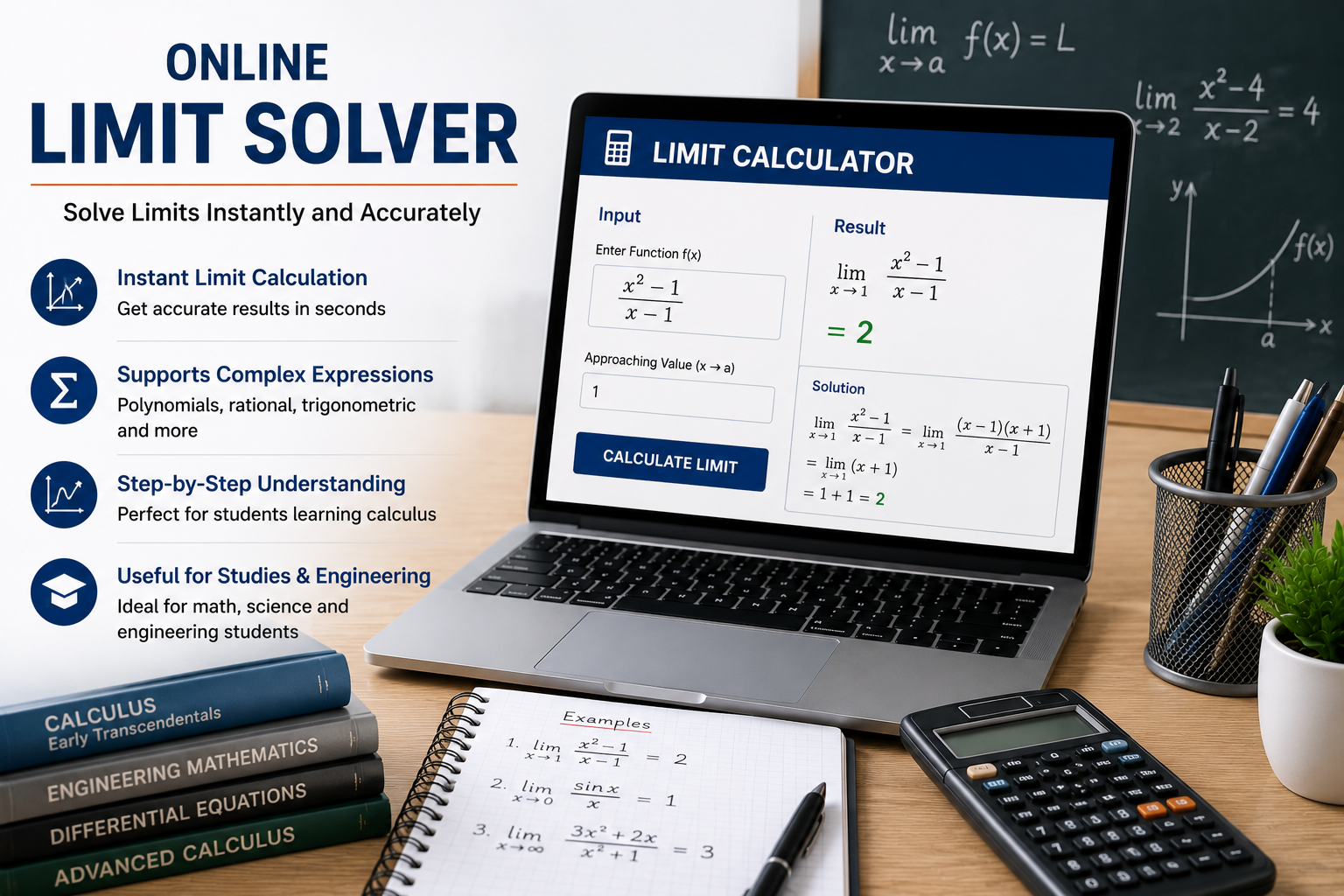
How to Use the Limit Calculator
Enter the mathematical function into the calculator input field. After that, type the value that the variable approaches.
Once you click the calculate button, the tool estimates the limit instantly and displays the result on the screen.
While studying advanced calculus concepts, many students also use our Laplace Transform Calculator to solve engineering mathematics and differential equation problems online.
What is a Limit in Calculus?
In mathematics, a limit describes the value that a function approaches as the input variable gets closer to a specific point. Even if the exact function value does not exist at that point, the surrounding behavior may still approach a fixed number.
Limits are foundational concepts in differential calculus and integral calculus. They are widely used to define continuity, derivatives, instantaneous rates of change, and infinite series.
In engineering and physics, limits help analyze motion, velocity, acceleration, optimization problems, and system behavior near critical points.
Common Types of Limits
Students studying calculus generally encounter several important types of limits:
- Left-Hand Limit: Evaluates function behavior as values approach from the left side.
- Right-Hand Limit: Evaluates the function from the right side of a point.
- Infinite Limits: Used when function values increase or decrease without bound.
- Limits at Infinity: Analyze behavior for extremely large positive or negative values.
- Trigonometric Limits: Frequently used in advanced calculus and engineering mathematics.
Standard Limit Formula
lim(x→a) f(x)
In this notation, the variable x approaches a specific value "a" while f(x) represents the mathematical function being evaluated.
Many university students solving multivariable calculus expressions also use our Double Integral Calculator when working with advanced integration and surface-related calculations.
Example of a Limit Problem
Consider the following example:
lim(x→2) (x² + 3x)
Substitute x = 2 into the equation:
(2² + 3×2) = 4 + 6 = 10
Therefore, the limit of the function as x approaches 2 equals 10.